What does it take to build the automation workforce behind the factory of the future?
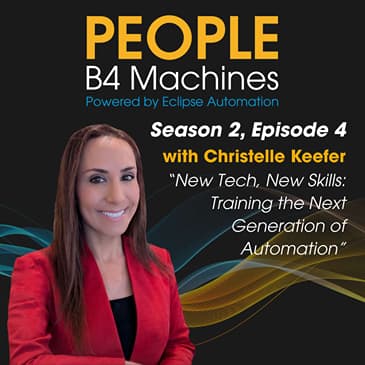
In this episode of People B4 Machines, host Amanda Cupido sits down with Christelle Keefer, Director of Training and Certification at the Association for Advancing Automation (A3), to explore how organizations can develop the automation workforce needed in an era defined by robotics, AI, machine vision, and rapidly evolving technology.
Workforce planning should begin before new equipment arrives. Manufacturers need to understand how automation will change jobs, identify skills gaps, determine who will operate and maintain new systems, and involve operators and technicians in planning. Clear communication can also help employees understand why technology is being introduced and how they will be supported as responsibilities evolve.
Christelle explains why training investments should address operational needs and job requirements. Rather than sending large groups through general courses, manufacturers can focus resources on employees whose roles require targeted development. Hands-on learning, internal mentorship, and train-the-trainer programs can help employees apply knowledge while retaining knowledge within the organization.
The conversation also examines the importance of foundational technical knowledge. Automation professionals need safety awareness, troubleshooting abilities, and an understanding of robotics, machine vision, controls, sensors, and connected systems. Vendor-neutral education can build transferable knowledge, while vendor-specific training can prepare employees to work with the equipment used in their facilities.
Preparing the next generation also requires collaboration between manufacturers and educators. Equipment access, classroom projects, facility tours, internships, and mentorship can introduce students to careers and connect education with industry needs. Accessible training, including clear instructions, captions, and hands-on activities, can support employees with varied learning needs throughout their careers.
Whether you’re a student, educator, manufacturing leader, or lifelong learner, discover how continuous learning can help build a resilient and adaptable automation workforce. The future of automation belongs not to those who know everything, but to those who stay curious, keep learning, and grow alongside technology.
For more bold questions and sharp insights, visit www.peopleb4machines.com. Remember, the future isn’t fully automated—it’s people-powered.
Don't look at AI, robotics, programming, and everything else and think I have to master all of this before I belong here. Start with the fundamentals, then find an area that you're passionate about that interests you, and then keep building from there.
IntroPeople B4 Machines. Conversations on the chaos of factory automation from Monday morning to the very near future.
Amanda CupidoWelcome to People B4 Machines. Conversations on the chaos of factory automation from Monday morning to the very near future. I'm Amanda Cupido, a speaker, author, and entrepreneur with a passion for the intersection of technology and humanity. Today, we'll be talking about training the next generation of automation talent with Christelle Keefer. She's the Director of Training and Certification at the Association for Advancing Automation, also known as A3, which prides itself for bridging industry, education, and advancing diversity and innovation. Christelle leads training, certification, and workforce initiatives across robotics, automation, machine vision, and AI. She is passionate about expanding access to automation careers and preparing talent for the future of advanced manufacturing. She has been recognized by the International Federation of Robotics as one of the 10 women shaping the future of robotics and as one of Oakland County's top 40 under 40 in 2025. Welcome to the show. Thanks for having me, Amanda. Oh, it's so great to have you here. And I'm excited to dive in. So let's do just that. You've spent your career at the intersection of technology and human potential. So I'm curious what you think is the biggest misconception about the modern automation workforce.
Christelle KeeferYeah, you know, Amanda, I think one of the biggest misconceptions is that you can invest in technology first and then figure out the people later. So companies seem to spend a lot of money on automation. And then once the equipment arrives, they start asking, well, who's going to operate it? Who can troubleshoot it? Who understands the safety requirements? And instead, what we should be doing is we should be planning ahead and asking, what skills will our people need? And how do we start developing those skills before the technology arrives? You know, we also need to move past the idea that automation is needing fewer people. As more tasks become automated, people may spend less time on the repetitive manual work and more time troubleshooting, working with data and understanding how different technologies work together.
Amanda CupidoAnd so speaking of that, there is a little bit of an upskilling that has to happen sometimes. And that's a real opportunity, though sometimes it is seen as a threat. And so, what advice do you have for leaders to help them frame it as the opportunity that it is? Sure.
Christelle KeeferYeah, it all starts with transparency. I wouldn't tell employees automation will never affect jobs because roles do change and employees can see that. So instead, leaders should explain what is changing, why the organization is investing in automation, what skills will be needed, and how employees will be supported in developing those skills. And I believe employees should be involved early on in the planning stages. You know, operators, technicians, they typically understand the process better than anyone. They know where the inefficiencies are, they know where the quality problems happen and which tasks are repetitive, difficult, or unsafe. So bring them into the conversation. Don't introduce the technology and then announce the workforce plan. Build the workforce plan into the automation strategy from day one. Um, and that changes the conversation from what is this technology going to take away from me to what opportunities could this create for me.
Amanda CupidoSo let's get specific. I mean, there's so much evolving right now. So, what would you say are the baseline skills a technician needs currently compared to five or 10 years ago?
Christelle KeeferYeah, so AI and advanced vision systems are making technicians' roles more interconnected. So they need a broader understanding of how different systems work together. That doesn't mean that every technician needs to be an engineer, but they do need to understand how the robot connects with vision, PLCs, sensors, safety systems, networks, and AI-enabled tools. So troubleshooting is also changing. It's not always as simple as, you know, this mechanical part failed. We now may be asking: is it the hardware? Is it the software, communications, the data, the vision system? Is it the process itself? So, you know, the technical fundamentals still matter, but adaptability and problem solving are just as important. And, you know, no one knows everything about every technology, but you you do need to keep learning as technology changes.
Amanda CupidoSo do you feel like educational institutions are helping to prepare folks who are wanting to enter the workforce? I mean, maybe a fun exercise might be to get you to give a grade on the current alignment between industrial automation companies and educational institutions.
Christelle KeeferYeah, so I think it really depends and it varies too much for me to give it a grade. But um, you know, you can have one school with an incredible robotics program and strong industry partnerships. Partnerships are huge. That's the baseline for success. Um, you may have another school where the students have almost no exposure to automation. But I really feel like coming from the industry side, you know, being at a large robotics OEM for 11 and a half years, industry has to do more than tell educators you're not teaching the skills we need. You know, education can't, and teachers can't be expected to keep chasing technology without industry helping them keep the pace. Industry, education, you know, those partnerships matter. What we pour into the next generation, what we pour into the educators is what we will get out. So we need to stop thinking of education as our talent supplier and start treating education as our workforce development partner, collaborating with teachers and students much earlier than high school. Uh so by the time the students graduate, they know our industry, they're confident, they know our companies, we know them, and that makes the transition into workforce much easier. And um, you know, industry should consider like how do we support educators through equipment, through industry expertise. Someone from the industry can come into the school to talk about their career path. And maybe a young woman will get inspired by another woman that was in the industry and she's like, wow, I never even thought, you know, I could get involved in automation. I don't even like math. I don't even like math, you know, but I'm involved in there's so much opportunity. It's just those relationships and those connections that really, really matter.
Amanda CupidoAnd I love that you talk about the younger, like the grade school students, because that's where sometimes some of the misconceptions begin. And so getting ahead of that, and it is quite inspiring to see how many like robotics clubs there are these days now. I don't know if you've witnessed that, but it's uh it's really incredible. I know they didn't have those around when I was in school. So it's nice to see how they're evolving. I know you're a strong advocate for vendor neutral stackable credentials. So why do you why don't you talk about that for a bit?
Christelle KeeferYeah, you know, people shouldn't have to start over every time technology changes. They should be able to build on what they already know. So that's the value of stackable learning. Someone might start with automation fundamentals, then they move into safety, then they add skills in robotics or vision controls. You know, as technology evolves, then your career is going to evolve. So it's really, you know, vendor neutral education is important because it teaches core concepts behind the technology, while vendor-specific training helps someone understands, uh, understand the particular robot or system they're working with. And they both have value. Um, but foundational skills like safety, learning about risk assessment, learning about troubleshooting and system design, that can all carry throughout your career. And that's the direction we're working in and working toward at A3 is the vendor neutral training, standards driven, practical, and designed to build over time throughout your career.
Amanda CupidoSo give me an example. Where can people go to learn more about some of the vendor neutral training, maybe that even A3 offers?
Christelle KeeferYeah, we have a website dedicated to training. It's automate.org backslash training, and you can see all of our online training, in-person training, virtual training, and certification programs.
Amanda CupidoNeat. All right. Now, I appreciate this about your career is that you've actually had quite a global career. You've worked across more than 40 countries. And I know sometimes we get caught up, especially in North America, in our own ways of working. And so are there any international examples of really great practices that you think we should be adopting?
Christelle KeeferUm, yes. So I believe, I believe we need to bring more of the of the factory into the classroom and more of the classroom into the factory. And one of the strongest approaches I've seen is when industry and education share the responsibility for learning. You know, students shouldn't spend years learning concepts and theory only to discover after graduation what a modern manufacturing environment looks like. So they need exposure earlier. And that could mean equipment installed at their facility at their um educational facility, working on industry projects, working in competitions that are sponsored by industry, doing internships, there's apprenticeships, work-based learning, facility tours, attending uh expos like Automate is huge. That's an event that A3 puts on. Um, other experiences developed with employers, you know, as long as there's that relationship and partnership early on and allowing the students to see like different case studies and get different case stories of automation used in the medical field or food and beverage besides the traditional, you know, automotive industry uh application. You know, the strongest programs create those ongoing relationships. And that's when classroom learning starts connecting to what's happening in the industry.
Amanda CupidoIs there a specific country that you were really in awe of when you were working?
Christelle KeeferYeah, I think Germany does an excellent job with how they upskill their next generation through the um through the education program, through, you know, the internships that they provide, the side-by-side mentorship programs they provide to expose the kids to the workforce and really prep them for success early on.
Amanda CupidoI love that. All right. I'm gonna have to do some digging in that space. Very cool. I also know that you're quite passionate about advocacy in this space and particularly helping traditionally underrepresented groups break into the industry, women break into the industry. What are some of the tips that you would give someone who is maybe trying to overcome some systemic barriers in getting involved?
Christelle KeeferYeah, so you can't choose a career you don't know exists. And one of the first barriers is exposure. If students aren't exposed to automation until they're in high school, we've already missed years of opportunity to help see themselves in those careers. And a lot of times, girls, females, young women, uh early on at the age of nine, they feel already like, yeah, mathematics is for boys, robotics is for boys. So, you know, it's really important that we have role models from the industry coming in and just telling about your story. There's no formal PowerPoint. I mean, it's just as simple as coming into a classroom, elementary school included, talking about your career path and inspiring that generation, that group of kids to see what industry is like and how how you've accomplished what you've accomplished. Representation matters also. So people need to see individuals from different backgrounds succeeding in technical roles. And then companies, when they're recruiting, have to think beyond recruiting. And, you know, sometimes a lot of effort goes into getting like diverse talent through the door, but not enough thought goes into what happens once they arrive. Do they have mentors? Are they being developed? Are they getting opportunities to work on important projects? Can they see a path forward? So, you know, success isn't just getting more people into automation. It's creating an industry where more people can be inspired and encouraged by each other. Then they enter, contribute, advance, and then hopefully stay with the organization.
Amanda CupidoI love that. And thinking about the long game and the entirety of the career, not just that first step of getting them in the door. Continuing on in this vein, I also know that sometimes there's a lack of representation even with neurodivergent talent. And so I find automation and digital tools can kind of be an equalizer, which is helpful. And it's really inspiring to see how that's been shifting. What have you noticed in that space?
Christelle KeeferIt's really important to develop with the people, not for the people. So accessibility isn't about lowering the bar, it's about removing unnecessary barriers. And it shouldn't be built in later. It should be built in from the beginning. A lot of the same practices that support people with disabilities or neurodivergent talent, improve learning for everyone. Think about it: closed captions, clear instructions, hands-on practice. Same applies to jobs. You know, focus on what someone needs to be able to do the job safely and successfully and not assumptions about what they can or cannot do. And ask people what would help them succeed and how can they be involved in making the project or technology successful?
Amanda CupidoWell said. Now you mentioned earlier you were alluding to some mentorship tips that you um have seen in practice. And I know that even sometimes unstructured mentorship can really play a role in helping with diversifying your talent force. Have you seen any examples of that in action? And can you share?
Christelle KeeferSure, yeah. And you know, talent can get someone in the door, but relationships help them understand what's possible once they're inside. And formal education can teach you technical skills for a career, but mentorship helps you learn and navigate the career. So sometimes the most important career development happens through a five-minute conversation. You know, it's someone telling you you should apply for that position, or come sit in this meeting, or let me introduce you to this person. Those moments build confidence, network, and a sense of belonging. I've benefited personally throughout my career from people who shared what they knew. They've challenged me, made introductions, and given me opportunities. I've actually mentored a middle school first robotics team for quite some time. And there's a young woman that wanted to just give up. And then I brought her to come see um the large robotics OEM that I used to work for. Uh, brought her in, gave her a tour, and then she told my her mom, she said, Mom, I don't want to be a singer anymore. I want to work for this robotics company. So that I mean, just little things like that. Just I think exposure is huge and believing in the next gen and giving them that confidence is huge. Taking the time to just plant that seed is important.
Amanda CupidoAnd you know, sometimes when I'm talking to folks about this, no matter what your industry, like we think of mentorship as this capital M mentorship, and we're meeting once a week, every week at this time. And it's no, as simple as a tour. I actually invite folks to come shadow me because I find that's usually a really easy thing to, you know, have somebody just tag along, watch what you do, and see if they respond to it. And that's a really nice way that you could carve a path for someone, right?
Christelle KeeferYeah, for sure.
Amanda CupidoWell, that's great. And I'm glad to hear you were able to even already make an impact on one person. That story is so sweet. I hope she really thrives in the space. Okay, let's shift gears a bit and talking about some hypotheticals. Okay, so if a manufacturing director or a facility manager, let's say, had like $10,000 to invest in their workforce's future this year, where would you recommend they spend that money?
Christelle KeeferThe money should go toward understanding the skills gap before buying any training. You know, don't start by finding a course and then sending everyone through it. Start with the business. What technology are you implementing over the next few years? What roles are changing? What capabilities do you already have? What are the actual gaps? So invest in targeted role-based development. And that might include, you know, automation, safety, robotics, vision controls, troubleshooting, AI. It all depends on what the facility needs. And then make sure that part of that investment includes hands-on application. That's invaluable. People need an opportunity to use and see what they've learned. It's the challenges, it's the breakdowns, it's the whys behind that set people up for success so that the next time that challenge comes up and they can recover more quickly. And then, you know, I would also invest in internal mentorship. And I know we were just talking like the big mentorship, but just having a relationship with your team or um, you know, there are things that a new person in the industry can learn from someone who's more experienced. And there's also something that someone more experienced can learn, you know, vice versa from somebody who's newer to the industry. So having that mentorship, having a train the trainer program, so the knowledge stays inside the organization. And, you know, I'd rather invest in developing 10 people intentionally than send 50 people through training that has no connection to their job.
Amanda CupidoSo yeah, that's good. A good tip. And now I'm gonna zoom it out even further, though. What if you had to convince a manufacturing director or facility manager that they should invest $10,000 in their people? What would you say?
Christelle KeeferI would say you have to invest in your people before the technology because if you invest in the technology and not the people, the technology may just sit there and collect dust. So it's your choice. Yeah.
Amanda CupidoAll right. And a message to a student or an early career worker who is fascinated by all of this, but maybe a little bit intimidated. What would you say?
Christelle KeeferI would say you don't have to outrun technology. You just have to learn how to grow with it. None of us know everything. I spent my career in the industry and I'm still learning because technology keeps changing. So don't look at AI, robotics, programming, and everything else and think I have to master all of this before I belong here. Start with the fundamentals, then find an area that you're passionate about that interests you, and then keep building from there. Ask questions, find, we keep saying mentors or find a person in the industry that you can shadow and you feel comfortable asking questions to. Visit manufacturing facilities, uh, attend industry events, automate again, is a great place to get exposure for students, educators, and industry. Take courses, get hands-on experience wherever you can. And I like to encourage students if they are at an age where they can create a LinkedIn profile, create a LinkedIn profile, start building those networks, start sharing projects or competitions you've worked on because you're going to get the attention of those employers and then networking, whether it's social or in person, is invaluable in my opinion. So, you know, the people who succeed aren't the people who know the most today. They're the people who stay curious, they stay adaptable, they keep learning, and they keep building their networks and relationships.
Amanda CupidoVery well said. And I agree wholeheartedly. I am a big fan of LinkedIn. And it's actually quite a positive platform, I find. People like to cheer each other on, like to learn from each other. And I think one more piece of advice I'm gonna add as a top-up is that like nobody knows everything. Everything is moving so fast. There's no one person who knows everything about robotics. Truly impossible. So everybody is on a learning journey, and so you just could be part of that journey yourself too, no matter where you're at. Um, it's, you know, there's no tip top. You're never check, I've learned everything, right? Impossible. Right, for sure. All right, and now, Christelle, I want to ask you what made you get into this industry?
Christelle KeeferI have loved manufacturing since I was a little girl. I was the kid that was up on the roof laying shingles with my dad. I was under the car body, you know, my dad was a tool and die maker. I saw him, you know, working with automation and welding. And then once I was in high school, I was mesmerized by the automotive industry. And I knew I wanted to work in the automotive industry. So uh right out of my bachelor's, I got my bachelor's in human resources, worked at automotive plants, manufacturing plants. So I was able to see and walk the floor every day and smell the cars being built and talk to the people building the cars and the robots sparking, you know, welding the car bodies. It was awesome. And then um, you know, got into doing my master's in instructional design, training, and development because I love learning new things and I loved being able to teach people new things as I learn new things. So um developed training for automotive FAA Ministry of Defense, and then got into working for a large uh robotics OEM and you know, been part of the network ever since. It's been great.
Amanda CupidoWell, it seems like you have landed in the perfect position. What a nice culmination of all of your background and skills. Yeah, thanks. All right, now before we let you go, we love to end with a curveball question. I already gave you one hypothetical, but now this one's gonna be for you. If you were magically made the secretary of automation and workforce futures, and let's just assume you had like unlimited budget and authority, what is the first rule or program you would roll out?
Christelle KeeferI love nonprofits, and I'm so blessed to work for a nonprofit right now. I would create a nonprofit to just expose kids to automation, maybe just purchase a large bus that could tour throughout the country to just showcase automation to kids, not only in schools, but in hospitals, just all over, so they can see possibilities, potential, and then you can have speakers on the bus. So that would be a dream.
Amanda CupidoOh, I love that. All right. Well, the seed has been planted. Maybe it will come true. Well, thank you so much for being on the show. This is great. Thank you so much, Amanda. It's been a pleasure. And thank you for tuning in to People B4 Machines Conversations on the Chaos of Factory Automation Powered by Eclipse. We're here to challenge the status quo in factory automation because machines don't build factories, people do. The technical producer for this podcast is Ryan Dentinger. I'm Amanda Cupido. Did you enjoy today's episode? I hope you did. And if so, I'm going to encourage you to share it with anyone in your network who is tired of the automation echo chamber. And of course, be sure to hit that follow button on your favorite podcast player. We've got more coming your way this season. And remember, the future isn't fully automated, it's people powered. Talk to you soon.
ExtroThanks for listening to People B4 Machines. Conversations on the chaos of factory automation from Monday morning to the very near future. For past podcast episodes, search people before machines on Spotify, Apple Podcasts, Amazon Music, YouTube, Eclipse Automation.com.