What happens when robots stop following rigid instructions and start understanding the world around them?
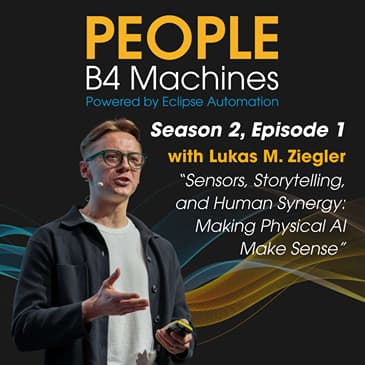
In this episode of People B4 Machines, Amanda Cupido sits down with robotics evangelist, angel investor, and content creator Lukas M. Ziegler to explore the rise of physical AI and what it means for the future of manufacturing.
Lukas explains world models, the technology helping robots reason, adapt, and interact with the physical world, and introduces the concept of the neo-integrator: a new approach to deploying robotics that relies more on AI-driven reasoning, teleoperation, and autonomy than traditional programming.
The conversation moves beyond technology to explore trust, safety, surveillance concerns, and the human impact of working alongside increasingly capable machines. Lukas shares why communication, education, and transparency will be just as important as engineering in the next wave of automation.
As an active robotics investor, he also reveals how he evaluates startups, separates innovation from hype, and identifies solutions that solve real-world problems.
The episode concludes with a look at the future of work, where robots take on more routine tasks, freeing people to focus on creativity, communication, and the things they enjoy most.
For more bold questions and sharp insights, visit www.peopleb4machines.com. Remember, the future isn’t fully automated—it’s people-powered.
World models are a way of training robots by providing them like reasoning capabilities, also manipulation capabilities, but also like just understanding what the world around us is.
IntroPeople B4 Machines. Conversations on the chaos of factory automation from Monday morning to the very near future. An Eclipse podcast.
Amanda CupidoWelcome to People B4 Machines. Conversations on the chaos of factory automation from Monday morning to the very near future. I'm Amanda Cupido, a speaker, author, and entrepreneur with a passion for the intersection of technology and humanity. Today, we'll be making physical AI Make Sense. We're going to talk to you about sensors, storytelling, and human synergy with Lucas M. Ziegler. He is an angel investor and the Chief Evangelist at botnanza, helping people get used to robots by telling the stories behind them. He has visited more than 150 robotics companies, turning factory tours and founder interviews into videos, posts, and a newsletter. His content reaches over 100 million people every year and includes a community of over 400,000 robotics domain experts. Since 2025, he has backed more than 20 early stage companies in robotics infrastructure, embodied AI, and the software layer beneath them, including Foxglove, Micro AGI, Nomagic, and Flexion Robotics. Lucas is a Forbes 30 under 30 honoree and a keynote speaker who has addressed audiences at the UN and some of the biggest Fortune 500 companies around the world. Lucas, thank you so much for joining me today.
Lukas M. ZieglerNo, Amanda, thanks so much for having me. And I feel flattered. Such a great introduction. Thank you so much for energizing me. I'm ready to talk about robots all day.
Amanda CupidoI love it. Well, you've done so many impressive things. So, and I know it's odd sometimes to hear it all read out right before you, but kudos to you. It's quite an impressive resume you've got. But I want to dig into one of the first, maybe the most basic thing of it all, which is your newsletter on Substack. It's called We Are All Robots. And I just want to know why did you choose that? What does that mean to you?
Lukas M. ZieglerYeah, so I know the name's quite controversial, especially that you know there is a lot of discussion if there's not going to be a displacement of jobs because of robots. For me, it was more like I strongly believe there is so many tasks, so many jobs that we should and we will outsource to robotics, just so you know, these tasks that monotonous tasks that we really do not want to spend time on, they should go to robots. I will extrapolate on that in hopefully in the in the in the next questions. But that was just some sort of, I wanted to have something catchy, I wanted to have something controversial. I started this uh newsletter in 2021, and you know, it's changed since then. Like right now, robotics is hot, right? It's like the it even got rebranded by the most popular and probably the most wealthy letter jacket in the world, Jensen, right, from Nvidia. And he renamed it from robotics to physical AI. So I think it's the space to be. But back in the days, when I started doing that newsletter, I wanted to, you know, get more, get more people involved somehow. So maybe that was sort of a a catchy hook. And it worked. So that's the story.
Amanda CupidoWell, you did a good job. And I mean, you've really evolved in the kind of content you've been sharing in the beginning. I think it was a lot of explainer pieces, but now obviously the industry has evolved quite a bit. What do you think is the main message right now that people are most interested in reading about?
Lukas M. ZieglerSo I think throughout the five years of creating that newsletter until now, I think my audience consolidated. I mean, if you are not into robotics and you're reading my newsletter, I'm I'm talking to you, like, please stop. Because probably like you shouldn't. So what I want to say, like, you know, throughout these five years, there was probably maybe 150 releases of my newsletter. Like you, if you're getting that week in week, right, and you haven't clipped that unsubscribe or hey man, please stop messaging me, then uh you must be into robotics. So there was some sort of a consolidation phase. So right now I have robotics investors, robotics researchers, people that want to that want to install robots or deploy robots, like manufacturers, warehouse people, or innovation people from completely new markets. I'm getting some messages from people from the biggest oil and gas refineries, and they're like, hey man, we would love to have some robots. Can you advise us on that topic? So I see a lot of eye rolls on the robotics topic. So I think I've evolved from explanation to more like news, what's happening in the space, what's hot, what's not. That's where I think it's it went to.
Amanda CupidoNow I am gonna pull back to some of your explainer roots, though, because I know you've written a lot about world models, and this is quite a hot topic. So can you explain what these are and how the tech works for those who might not have ever heard about them?
Lukas M. ZieglerYes. So let's get back to 2022. I think it was the end of November when uh Sam Altman dropped uh ChatGPT free, and it completely changed our lives, I think. No, I don't think, I'm sure. And it changed our lives in business, it changed and our personal lives. Like, you know, we manage our calendars with AI, we plan our travels with AI. I look up even when I was cooking for my wife, I was looking at the recipes on ChatGPT. So I we are using it literally for everything, doing research in seconds. But this is purely digital, right? It has nothing to do with the physical world, which is much harder. It's about interacting with physical things. So one could say, all right, we got ChatGPT free, so probably soon we're gonna have like a chat GPT free moment for robots. And here I want to say there's not gonna be like an explicit one ChatGPT moment for robotics. I'm gonna tell you now, right now. All these LLMs were trained on the massive flow and data from the internet. That was literally for free, like books, YouTube videos, like literally just narrowed down to text. So it was there, like the data wasn't a problem, right? But in robotics, if you think that you want to train a robot to pick something or to identify something, you need more than just words, right? You need to be able to describe it in bits. Sorry, not with bits. You must actually uh make the robot understand it in atoms because it's gonna be interacting with the real stuff. So, world models are a way of training robots by providing them like reasoning capabilities, also manipulation capabilities, but also like just understanding what's the world around us is. They have something with from the LLMs. So, for example, description of the world. If you look at my living room here, I I've got a table, I've got an oven, I've got a chair, and robot needs to know what's a chair is, and it is that and it that it's named chair, because for example, you would like to give it any command, but it also needs to understand what is the physicality of that chair. Can I sit on it? Can I move it? What actions are possible to do with that, right? So you need to have this spatial intelligence, which is way harder than you know regular LLMs. So, world models is a way to make robots smart, autonomous, and capable of interacting with what we have here. This is not a very technical definition, but I believe that we want to start from scratch. And we want to literally make sure that everyone that listens gets an understanding what's the fuss about world models, VLAs, and stuff like that. So that would be it. And just a fun fact if someone says, yeah, that's just a research. Not really. Actually, last week, AMD has acquired World Labs, co-founded two years ago by Feifei, one of the OG researcher in this space for more than $8 billion. So, no, it's real, it's already here. So you gotta bet to know what's the technology behind it. So, yeah, that's world models in a nutshell.
Amanda CupidoLove it. And that's why we're including it in the podcast, just in case. We gotta get people on the same page. So I think it's perfect that we gave you that platform to explain it. All right, I have one more explainer question I'm gonna ask you before we zoom out and talk more psychologically about everything. But you know, there's many leaders that are still relying on older approaches like PLCs, scatter, and custom build logic. So can you explain how those differ from a neo integrator?
Lukas M. ZieglerAbsolutely. Yeah. So a neo integrator is a new term of classical system integrator that got into world models. So if you remember, I mean, they are still here. So the system integrator model is typically to build a machine, build a system, spend tons of engineering hours into that, right? That's their main business. The promise of world model tells us that we can accomplish a task with a robot without an explicit programming effort that you would do. So we are literally removing a majority of these engineering hours. So your project breakdown looks different. Also, characteristics that Neo integrator is bringing are different. For example, teleoperation, which is a way of remotely operating a robot from a remote location, is also another kind of a feature of a neo integrator. For example, he can accomplish a job if the robot is in an edge case, so an unpredicted case for this robot, and he can manage that task or finish that task or actually get a robot out of an uh complicated situation just by operating a joystick or a gamepad and you know get that robot out of that position and the robot keeps working. So it's gonna be a slightly different approach to deploying robots. It's gonna be less about caring about software, because as we've mentioned, the world models promise that there is no software. There is like pure reasoning of the robot and you telling the robot what the robot needs to accomplish, and you, you know, setting the framework, what is the the job, how you describe the job. So it's gonna be it's gonna be a new paradigm when it comes to you know integrating robotics. And there will be people saying it's not gonna be like this. Um I'm I'm sure there will be. I think we people hate change. But I'm happy to be here and actually talk about something that's upcoming, and there's gonna be definitely a change. Because if you extrapolate all that, like compute, data, all these advancements, talent and capital flowing in that. We people are good at one thing. If you give us all of that, we are good at solving problems. And I'm pretty sure we're gonna solve crack that one too. So that's the neo-integrator in a nutshell. It's gonna be a new wave of companies, more lean companies, not having so many engineers behind them because they they can do the project more cost-effectively, quicker, and using less tools. But you mentioned PLC and scatter systems. That's also something I'm really into because actually I studied automation systems. So I believe these will be still valid. I still believe in agenting AI will take over a little bit in this programming of these PLCs, but I think logic will be very important because it's also connected to safety. And as we know, world models are great. I I mean I love them, but they are very often non-deterministic. So you cannot always say what they're gonna do next. They are probabilistic. And you know what? These people in manufacturing space they hate probabilistic things because you've got a risk analysis, you've got a certification, you need to know how to act in every step of a program. So I believe that tech it's it's actually true, that the technology progresses much faster than standardization. I think there must be like an you know a time where there's gonna be like you know, back and forth, you know, couple of sites fighting each other a little bit. So that's how I see it.
Amanda CupidoFascinating. Oh my gosh, you've dropped so many bombs there. I feel like people might be having their head exploding with some of these concepts, including like drawing back to you saying, yeah, I see a world, no software. And it's like, but how could there be no software? Because that's all we've known. But this is why people compare this deep learning revolution to the industrial revolution, because it is just a completely different way of working. And you have to unlearn so much, right?
Lukas M. ZieglerYeah, actually, that's a great quote. Yeah, you gotta be able to unlearn very quickly these days. Just so it's not gonna be the hook of the post after publishing the podcast. It's not like there's gonna be no software. Everything's gonna be software, but we and you, and you, and and other integrators, you are not going to write a line of code. That's what I meant. Yeah. Everything is gonna be software, but you are never writing that software.
Amanda CupidoIt's just it's not software the way we know it.
Lukas M. ZieglerYes, exactly. Exactly.
Amanda CupidoYeah, yeah.
Lukas M. ZieglerI know, which is still scary concept. Ways of interacting, yeah. Ways of interacting with robots and software, it's already different. You can ask, like, you know, software developers, like how they right now code. How they like, do they code? I don't think so. They just run their agents and their agents just explore new stuff and they test stuff and they code for them. And they are more like, you know, the authorization body. Managers. Yeah, managers, authorization body. Like that doesn't work. Okay, it looks good. Okay, let's let's let's put it on the production.
Amanda CupidoAnd do you find that when you speak about this, even from all the stages you've been on, do you have people coming up to you after going, I disagree? No, like are they fighting you on it?
Lukas M. ZieglerAbsolutely. And I love that. I bet. Because otherwise, I don't think I would be do something meaningful if everyone agrees with me. If you're pursuing a big market, a new market, people must disagree with you. And uh because it means that there's gonna be a big change, because when there's resistance, you can feel that. So of course they disagree. Although I've never had any kind of you know aggressive, you know, acts. It was more like, you know what, uh no, that's my counter-argument. And I don't think it's gonna, it's gonna then we go into a, you know, a classical debate and we just talk and exchange arguments. And it's it's also not about convincing people. I believe it's about making people aware that something is coming. Because I believe robotics are gonna be ultimately the biggest market that we can imagine uh in the world. So as I said, literally just to build awareness so they they they know that something something's coming at them, so they can prepare themselves. And and actually just by preparing themselves, it means that they can take advantage. Because I'm sure not everyone will prepare themselves. Not everyone will believe that. So if you believe, it's already a good step of having an uh, you know, an edge on over other people.
Amanda CupidoSo we've talked about some of these like maybe resistors or naysayers. The other end of the spectrum are people who are all trying to make a buck and trying to come out with the latest craze with technology and you being a a new angel investor, I'm sure you've just seen a lot of pitches come your way. And so I am sure that there are some startups that are building stuff just to for the clickbait, for the hook, for the PR pitch. And then there's some that are actually solving real human problems. So, how do you delineate who's got the goods?
Lukas M. ZieglerYeah, I mean, I'm obsessed about robotics. So if you if you look at the Chinese uh robot Olympics, and I'm sure you did see this, uh robots, you know, sprinting and doing different disciplines in the kind of Olympic Games. Yes. People say it's, you know, it's BS, but for me, actually, this is making sure that robots can go more mainstream and actually leading to people accepting them socially. You have a mechanical creature and you're going to see it run. All right, cool. Robots got your attention. That's pretty important, all right? Right now, how do you like there is a lot of gimmicks, but there is also a lot of meaningful companies doing real stuff with customers. Couple of questions. Can you name the customer who is using your robots? Can you tell me what task your robot is doing and why this task is being done by a robot 2.0, so with this word motor, rather than a simple machine that we know for more than 70 years from, you know. The first robot I think was like implemented in General Motors in like 1960s. So why would you bother to throw so much compute and so much researchers to solve that if that was already solved, right? So what's the task? What's the cost of that task? If he names a customer and he comes with a task that was previously not able to automate, I'm buying it. This is why we need those robots to automate what hasn't been what wasn't wasn't it just wasn't able to be automated by classical, traditional legacy robotics solutions. These are like typical, you know, kind of questions. Then I obviously ask about the performance and the efficiency, right? What's the cycle time? Is it better than the human, right? Because in the end, why we have robots? First of all, we lack people. I don't want to talk demographics here, right? I'm not a demographics expert, but um, if you ask me, I would say that we are way below the you know, um, fertility rate, which the United Nations demographers typically frame like this. In order to have a healthy economy, you should have these fertility rate at 2.2. One for mommy, one for daddy, 0.2 for the sake of growing economy. We don't have that. We don't have that. So does it mean that we want to produce less, or you know, or do we want to order less stuff from Amazon? Actually, it's quite the opposite, right? I cannot wait when I get my package tomorrow. And it's better be there tomorrow. It's better be there tomorrow. Expectations are crazy, the demand has been crazy. So robotics is not like I'm super happy we do not have any more of those displacement discussions that often on the headlines. Because people understood that robots will be more efficient, more productive in environments where we benefit from. And that's it. So that's why I also, you know, ask them about the recovery from failure, the edge cases. How much does it the job out of 10 times? And this is more like a question about like, you know, technology, technology uh readiness level, rather than is it a good stuff or bad stuff? Because you can be at the beginning and you're just developing a solution. So at some point you can get there. But it's just your those are the filters that I'm asking those people when it comes to solutions, because there is much more questions, like you know, like who's on your team, what's the experience, why are you doing it? Uh, what's your you know, internal and external motivation to do that? But when it comes to solutions that you've asked, that's typically my framework, how I screen these companies.
Amanda CupidoThat's fascinating. And I'm sure some great tips for people who might be pitching you soon. So there you go. A little line of sight into how he's thinking.
Lukas M. ZieglerI mean very happily spending money to the disappointment of my wife on Angular Investments. So if you have something cool in robotics, uh, you know, my DMs are open. Yeah.
Amanda CupidoThere you go. All right. But you talked a lot about humans working with machines, being more open to that conversation. And so I think it's great to shift the conversation actually to dig in there. And, you know, when we talk about removing safety cages, typically it's seen as a technical milestone. But I do think that when we remove that on the shop floor, there is a psychological shift for the human that is working beside that machine. What have you noticed in that area?
Lukas M. ZieglerOh, yeah. So I think, you know, removing cages is a very known procedure because of collaborative robots and cobots. I think this is how those machines were advertised. For those who don't know, cobots were promised to be, and are actually a safer version of robots because of a bunch of sensors being placed in their joints so they can technically feel, and if they hit something, they can stop, and they are just way safer than the classical, you know, big, gigantic robots that you are seeing that are welding uh, you know, body-in-wide uh cars in BMW, for example.
Amanda CupidoRight.
Lukas M. ZieglerI cannot imagine a use case for a humanoid that is being caged from uh from a type perspective. So you're right. That's also sort of my mission to make sure that people don't feel intimidated, that people are not scarred, that people trust these machines enough. And we are far away from that world where you you see, you know, a guy passing something to a humanoid. If you think of that, right now it's definitely happening behind cages, and it's not like people are working with these machines. On the other side, I see a strong signal from the unionists that they are not very happy about having not just a robot, because that was always a problem, but a robot that looks like us. All right, that's next level. So I believe there is a lot of work on education and a slow and gradual deployment of those machines into our lives, and proving that they are adding value, that they are actually helping us. And someone said, Okay, man, this is blatant, like say a use case. All right, let's look at this like this. You've got a couple of people working in a factory. And as we know, Gen Z's favorite pursuit careers are influencers, being a YouTuber, definitely not being uh you know, a production worker or go to a warehouse. Like these are not very pursuit career trajectories these days. So just imagine the guy that used to. Deal with an X amount of work, suddenly loses two of his employees because they are just out of business and he needs to deal with that work. Then automation comes in. And I think the best answer to convince people for automation in robotics is actually using it in the most kind of necessary moments. And that's where robots are, you know. That's why that's why robots are for. And I believe this is that it's gonna be a process. It's never gonna be like, you know, instant moment, okay, cages, no, no cages. It's gonna be very gradual. Some companies might be more restrictive, some companies might be more experimental about it. But um I think for now it's gonna it's gonna stay as it is. Machines on one side, especially I I'm talking about humanoids, especially bipeds. It's it's it's because it's they are very unpredictable from the locomotion perspective. I mean, I wouldn't like if I'm a worker, I don't want to have 70 or you know, 100 kilograms, some of them are like this, fall over me, right? I don't want that. Yeah. So safety perspective, too. I think that it's gonna take some time.
Amanda CupidoAnd then the other layer to all of this, you mentioned the sensors, which is how they know where to go and who's there, but then the sensors can be seen as surveillance, people are freaked out by that. So, how do you talk about like towing that line about the importance of sensors so that the cobots can do their jobs efficiently and where privacy and safety from a surveillance perspective comes in?
Lukas M. ZieglerYeah, great question. I think when we talk about sensors, the most feared ones are cameras. They are not sensors technically, but uh we can put it in one group of products. I think people are mostly scared about cameras. I mean, we know George Orwell, 1984. We know what's happening in China, we know these kind of surveillance uh issues they have. We don't want it in the Western world. I'm gonna repeat myself. It also starts with education and assurance. Assuring people what are the guardrails, what are the privacy methods used to make sure that everything that's recorded is proprietary data of the company, or for example, it it cannot detect a person by a face because it's immediately blurred. There is a lot of ways of doing that from the technical perspective. So, from technical perspective, I'm absolutely sure this is easy to work with. But on the top of that, not just technical perspective, you need to have this kind of you know PR perspective. You need to articulate it well to your people, how it works, why you have that camera in there, what it brings to the business, and why they should not be scared of that. Nobody's recording you. We want to do, I don't know, quality checks with cameras, or we want to scan the environment for the safety reason with cameras. So it's about educating those people. If people see cameras, regular people that are not into tech, we are often very biased. Like me, you, we are tech enthusiasts, right? But not everyone has the same level of enthusiasm towards tech. That's why it's very important to talk about it. Why the camera is here, what the camera can do, what it cannot do, what are what are the guardrays, what are the privacy assurance to make sure that, you know, nothing leaks. That's how I saw plenty of Fortune 500 companies approach that.
Amanda CupidoAs you're curating your content and looking ahead, you know, your Substack has already evolved so much. If you're gonna look ahead like 10 years from now, what do you think you'll be writing about?
Lukas M. ZieglerOh, I hope it's not gonna be me. I hope it's gonna be some sort of uh, you know, a robot in actually writing. So I'm I'm very bullish on of this or or of the soft skills. I think it's gonna be like a golden age of soft skills. What we do, talking, writing, you know, creating art. This is something I would love to people to focus on in their free time. And I think it's that's what I can communicate to people. There's gonna be a lot of robots. So you better find out what you like to do in your free time. Just just in case, if I'm right. And uh I'm not saying the work's gonna be abandoned. I'm not quoting Elon Musk. I don't fully believe in that. But robots might make our lives easier, not just in factories. When we get home, we might have our own the out straight out of Jetson's Rosie the robot doing uh you know, doing the dishes, preparing the dinner, cleaning up after us. So we better find out what we like because I think these days we are so busy. We are so in present that we better find out what we really enjoy doing in life because it might be it might be very helpful when when we have time on our hands finally. And that's what I believe robots will bring us.
Amanda CupidoThe golden age of soft skills, I love that. That needs to be a bumper sticker. Um one last question before I let you go. I always end with a curveball question. And so making it kind of personal to you, what is one task, maybe a daily, mundane task that you think you will hold on to forever? If you had to pick one to never hand over to an automated gadget, what would that be?
Lukas M. ZieglerThat I would never hand over, or I would definitely hand over.
Amanda CupidoThat you would never hand over. I think it's easier to it's easier to say what you would.
Lukas M. ZieglerNever hand over. Okay, let's do two. Um uh I would never hand over. Okay, it's gonna be personal, right? So I would never hand it over to Waymo. I love driving my car. I enjoy it. I don't know why. I love doing cargo karaoke. I just enjoy it. I just enjoy it. I I have my own world when I'm driving. So driving a car, second thing what I wouldn't uh hand over, I would say cleaning, but that would be a clear PR shot. So just driving. You stay on Luke driving. Take the cleaning, take the cleaning, everything, everything from my household uh kind of course, take it immediately.
Amanda CupidoI agree. All right, Lucas. Well, this has been a real laugh, and and I learned a lot too. So thanks so much for your time.
Lukas M. ZieglerAbsolutely. Amanda, thanks so much. And uh yeah, may the robots be with us. And hopefully there's gonna be a future where we can coexist and robots can bring us a lot of joy and a lot of uh a lot of value. Thanks so much again for the invitation.
Amanda CupidoI hope so too. You're so welcome. All right, that's a wrap on the first episode of season two here on People B4 Machines conversations on the chaos of factory automation powered by Eclipse. Thank you for listening. We are here to challenge the status quo in factory automation because machines don't build factories, people do. The technical producer for this podcast is Ryan Dentinger. I'm Amanda Cupido. We hope you enjoyed this episode, and we've got an entire season full of fantastic conversations like this one. So be sure to hit that follow button on your favorite podcast player and share this link with peers in your network. Remember, the future isn't fully automated, it's people powered. Talk to you soon.
ExtroThanks for listening to People B4 Machines. Conversations on the chaos of factory automation from Monday morning to the very near future. For past podcast episodes, search People B4 Machines on Spotify, Apple Podcasts, Amazon Music, YouTube or www.eclipseautomation.com.